|
Honda
2009
News
March
- Brawn GP - Virgin
- Richard
Branson deal adds new life to Formula
1
Branson
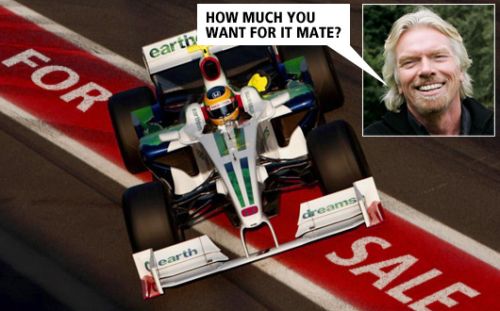
set to sponsor Brawn GP - 28th March 2009
British
entrepreneur Richard Branson's Virgin Group has
been lined up as the new Brawn GP team's first
significant sponsor, according to Formula One
supremo Bernie Ecclestone.
"Virgin
and Brawn have come to commercial terms which
he (Branson) thinks are viable," Ecclestone
told The Times. "Both he and the team are
happy.
"I've been pushing, pushing, pushing and
pushing. I am delighted they have just got going
on it and have a deal in place.
"It's good for the team, it's good for Formula
One, I'm very happy with it."
There was no immediate comment from the team at
the season-opening Australian Grand Prix, where
their British driver Jenson Button and Brazilian
Rubens Barrichello are favourites to win on Sunday.
Brawn have risen from the embers of the Honda
team after the Japanese manufacturer announced
in December that they were pulling out of the
sport due to the credit crunch.
Their Mercedes-powered car, the legacy of a year
and a half of intense work by Honda, has looked
very quick in pre-season testing.
Branson had been linked to the team as a possible
purchaser before Honda accepted a management buyout
led by former principal Ross Brawn.
The Times said the multi-million dollar deal was
expected to be announced on Saturday with Branson
flying to Melbourne for the occasion.
Profile
Honda
Motor Company, Limited, Honda Giken Kogyo Kabushiki-gaisha,
Honda Technology Research Institute Company, Limited),
shortened to Honda is a multinational corporation,
engine manufacturer and engineering corporation
headquartered in Japan.
The
company manufactures automobiles and motorcycles,
trucks, scooters, robots, jets and jet engines,
ATV, water craft, electrical generators, marine
engines, lawn and garden equipment, and aeronautical
and other mobile technologies. Honda's line of
luxury cars are branded Acura in North America
and China. More recently they have ventured into
mountain bikes.
Honda
is the 5th largest automobile manufacturer in
the world as well as the largest engine-maker
in the world, producing more than 14 million internal
combustion engines each year. Currently, Honda
is the second largest manufacturer in Japan behind
Toyota and ahead of Nissan.
Honda
is headquartered in Tokyo, Japan. Their shares
trade on the Tokyo Stock Exchange and the New
York Stock Exchange, as well as exchanges in Osaka,
Nagoya, Sapporo, Kyoto, Fukuoka, London, Paris
and Switzerland. American Honda Motor Co. is based
in Torrance, California. Honda Canada Inc. is
headquartered in the Scarborough district of Toronto,
Ontario, and is building new corporate headquarters
in Markham, Ontario, scheduled to relocate in
2008. It was originally planned to be located
in Richmond Hill, Ontario, but delays led them
to look elsewhere.Hero Honda, a joint venture
between India's Hero Group and Honda, is the largest
manufacturer of two wheelers in the world. Honda
of Canada Manufacturing is based in Alliston,
Ontario. Honda has also created joint ventures
around the world, such as Honda Siel Cars India
Ltd, Hero Honda Motorcycles India Ltd, Dongfeng
Honda Automobile Company in China and Honda Atlas
Cars Pakistan.
Racing
history
Motorcycle
Honda
Racing Corporation (HRC) was formed in 1982. The
company combines participation in motorcycle races
throughout the world with the development of high
potential racing machines. Its racing activities
are an important source for the creation of leading
edge technologies used in the development of Honda
motorcycles. HRC also contributes to the advancement
of motorcycle sports through a range of activities
that include sales of production racing motorcycles,
support for satellite teams, and rider education
programs.
Soichiro
Honda, being a race driver himself, could not
stay out of international motorsport. In 1959,
Honda entered five motorcycles into the Isle of
Man TT race, at that time the most prestigious
motorcycle race in the world. While always having
powerful engines, it took until 1961 for Honda
to tune their chassis well enough to allow Mike
Hailwood to claim their first Grand Prix victories
in the 125 and 250 cc classes. Hailwood would
later pick up their first senior TT wins in 1966
and 1967. Honda's race bikes were known for their
"sleek & stylish design" and exotic
engine configurations, such as the 5-cylinder,
22,000 rpm, 125 cc bike and their 6-cylinder 250
cc and 380 cc bikes.
1979
saw Honda return to Grand Prix motorcycle racing
with their exotic, monocoque-framed, four-stroke
NR500. The NR500 featured elongated cylinders
each with 8 valves and with connecting rods in
pairs, in an attempt to comply with the FIM rules
which limited engines to four cylinders. Honda
engineered the elongated cylinders in an effort
to provide the valve area of an 8-cylinder engine,
hoping their four-stroke bike would be able to
compete against the now dominant two-stroke racers.
Unfortunately, it seemed Honda tried to accomplish
too much at one time and the experiment failed.
For the 1982 season, Honda debuted their first
two stroke race bike, the NS500 and in 1983, Honda
won their first 500 cc Grand Prix World Championship
with Freddie Spencer. Since then, Honda has become
a dominant marque in motorcycle Grand Prix.
In
motocross, Honda has claimed 24 motocross world
championships.
Automobile
Honda
entered Formula One as a constructor for the first
time in the 1964 season at the German Grand Prix
with Ronnie Bucknum at the wheel. 1965 saw the
addition of Richie Ginther to the team, who scored
Honda's first point at the Belgian Grand Prix,
and Honda's first win at the Mexican Grand Prix.
1967 saw their next win at the Italian Grand Prix
with John Surtees as their driver. In 1968, Jo
Schlesser was killed in a Honda RA302 at the French
Grand Prix. This racing tragedy, coupled with
their commercial difficulties selling automobiles
in the United States, prompted Honda to withdraw
from all international motorsport that year.
After
a learning year in 1965, Honda-powered Brabhams
dominated the 1966 French Formula Two championship
in the hands of Jack Brabham and Denny Hulme.
As there was no European Championship that season,
this was the top F2 championship that year. In
the early 1980s Honda returned to F2, supplying
engines to Ron Tauranac's Ralt team. Tauranac
had designed the Brabham cars for their earlier
involvement. They were again extremely successful.
In a related exercise, John Judd's Engine Developments
company produced a turbo "Brabham-Honda"
engine for use in IndyCar racing. It won only
one race, in 1988 for Bobby Rahal at Pocono.
Honda
returned to Formula One in 1983, initially with
another Formula Two partner, the Spirit team,
before switching abruptly to Williams in 1984.
In the late 1980s and early 1990s, Honda powered
cars won six consecutive Formula One Constructors
Championships. WilliamsF1 won the crown in 1986
and 1987. Honda switched allegiance again in 1988.
New partners Team McLaren won the title in 1988,
1989, 1990 and 1991. Honda withdrew from Formula
One at the end of 1992, although the related Mugen-Honda
company maintained a presence up to the end of
1999, winning four races with Ligier and Jordan
Grand Prix.
Honda
debuted in the CART IndyCar World Series as a
works supplier in 1994. The engines were far from
competitive at first, but after development, the
company powered six consecutive drivers championships.
In 2003, Honda transferred its effort to the rival
IRL IndyCar Series. In 2004, Honda-powered cars
overwhelmingly dominated the IndyCar Series, winning
14 of 16 IndyCar races, including the Indianapolis
500, and claimed the IndyCar Series Manufacturers'
Championship, Drivers' Championship and Rookie
of the Year titles. In 2006, Honda became the
sole engine supplier for the IndyCar Series, including
the Indianapolis 500. In the 2006 Indianapolis
500, for the first time in Indianapolis 500 history,
the race was run without a single engine problem.
During
1998, Honda considered returning to Formula One
with their own team. The project was aborted after
the death of its technical director, Harvey Postlethwaite.
Honda instead came back as an official engine
supplier to British American Racing (BAR) and
Jordan Grand Prix. Honda bought a stake in the
BAR team in 2004 before buying the team outright
at the end of 2005, becoming a constructor for
the first time since the 1960s. Honda won the
2006 Hungarian Grand Prix with driver Jenson Button.
Honda
Racing F1 Team is a Formula One team run by Japanese
car manufacturer Honda. The team is based in Brackley,
United Kingdom, and uses the facilities of former
British American Racing, which Honda fully acquired
in 2005. Engines are built at the Honda R&D
facility in Tochigi, Japan.
Ross
Brawn was recently appointed team principal. Honda's
current drivers are Jenson Button and Rubens Barrichello.
The team began by using the same predominantly
white livery that Honda used in the sport during
the 1960s, but has since switched to a livery
dubbed the "Earth Car", with minimal
corporate advertising, and depicting the planet
earth and space.
2008
On
July 19, 2007, it was announced that Barrichello
and Button will continue the factory effort as
teammates into 2008. On November 12 2007, autosport.com
confirmed that former Ferrari technical director
Ross Brawn is to join Honda as team principal.
Nick Fry will remain with the team as Chief Executive.
On the 10th January 2008, it was announced that
Alexander Wurz had signed as test driver for the
2008 Formula One Season. On 29 January 2008, Honda
launched their 2008 race car. The "Earth
Car" has a slightly different livery from
its 2007 counterpart, with only part of the car
containing the earth picture, and the rest with
Honda's classic white paint. Button, Barrichello
and Wurz were present at the launch. (Credit:
Wikipedia).
Websites
Honda
Honda
F1
Profiles
Auto
|

