|
Documentary
News
Media
Flashback
A
Google documentary | Trillions of questions, no easy
answers
17
Oct 2020
This
Google documentary starts in a dusty basement with
boxes of old footage, like a typical home movie. Some
conversations in 2019, a field trip to a data center,
and an unexpected stop at a hardware store later,
it came together into a story–our story. Like
all home movies, there’s a good chance that the
only people who will swoon over it are the people
who are in it. But, if you’ve ever wondered how
Search works, or are curious to see what goes on behind
the scenes, there may be something here for you too.
Transcript
(part)
(Full
trascript via YouTube, while watching the documentary)
[TYPING SOUND]0:00
[MUSIC
PLAYING]0:06
NARRATOR: This is Louis XIV, also known as Louis the
Great, Louis the Grand Monarch0:12
and Louis the Sun King. Famous for supposedly declaring
"l'etat, c'est moi."0:20
But in 1685, even the self-declared direct representative
of God on Earth had questions he could not0:27
answer on his own-- questions about the ruling Qing
dynasty in China.0:33
How big is it? How many people live in the capital?
What can they teach us about music?0:38
Culture? Astronomy? So in the spring of that year,
Louis0:44
sent members of France's order of royal mathematicians
on a voyage that would span three continents and three0:51
oceans. Their task-- gather information that would
satisfy the King's curiosity.0:57
1:03
It was a journey with numerous hardships and countless
setbacks.1:11
But five years four months and two days1:18
later, Louis's answers finally arrived.1:23
In the grandest of human traditions, he had become
curious, asked a question,1:28
and learned a new piece of information, just like
billions of people who had come before him1:34
and billions who have come since.1:41
People who had access to cave walls, clay tablets,
oracles, scrolls, books, the printing press, libraries,1:46
semaphore towers, telegraphs, the radio, the television,
Betamax tape, and the short-lived French national1:53
internet system called Minitel. [ELECTRONIC VOICE
SPEAKING FRENCH]2:00
Which brings us to today.2:07
Fishermen looking up when tomorrow's tide comes in.
Careful cooks wondering when anchovies expire.2:14
Travelers trying to figure out how to say Chapstick
in Turkish. Friends settling a bet about which team2:21
won the '92 NBA Eastern Conference Finals. Job seekers
looking to make a move.2:27
And a fourth grader looking at facts about the Qing
dynasty for a history paper that's due tomorrow.2:33
Billions of King Louis asking trillions of questions
in hundreds of languages, expecting someone2:40
to give them an answer in under one second.2:47
Now, who would sign up for a challenge like that?2:53
BEN GOMES: Interesting setup. CREW: Yeah. [MUSIC PLAYING]
NARRATOR: This is Ben Gomes.3:03
BEN GOMES: Well, the correct pronunciation is "Gah-mez."
NARRATOR: This is Ben Gomes.3:08
BEN GOMES: But I say "Gohms." It's a Portuguese
name. NARRATOR: This is Ben Gomes. He knows a few
things about search.3:14
Uh, that search. Anyway, he's kind of a big deal,
even though he'd3:21
try to convince you otherwise. Ben worked on Search
for more than 20 years.3:28
But that's now where his story started. BEN GOMES:
So I was born in Dar Es Salaam in Tanzania.3:33
But at a very early age, my parents moved back to
India to Bengaluru. And there was a few books at home
from my elder siblings.3:39
And that's the information I had access to, including
I remember one torn encyclopedia that I think my grandfather
had given3:46
my mom. So it was really out of date. In 5th grade,
I got two presents--3:53
a bike, which my parents thought I'd be very excited
about, and a much better encyclopedia. And I was actually
much more excited4:00
about the encyclopedia-- this is where geeks come
from-- than the bicycle.4:05
And my parents didn't know what to do with this. [MUSIC
PLAYING] When I look back at how we found information,4:11
it was so dramatically different from today. When
my mother was growing up, where there was not even4:19
access to a good library, you would have just accepted
the fact that you didn't have the information, and
that's the way it was going to be.4:26
When I was growing up, for some kinds of information,
there was a decent library. But you still had to take
this bus. It took about an hour.4:33
You had to look things up in a card catalog. That
took time. Now today, we measure in fractions of a
second the time4:38
it takes for you to get information. I think that
reduction in friction is absolutely dramatic, because
it can enable people4:45
around the world to have equal access to information.
It's not just that people in some places who have
access to the best libraries.4:53
Everybody should have access to the highest quality
information. So that combination of a deep technical
problem and I4:59
think a fundamental human need to understand the world
around us, to know more about the world around us,5:07
is the heart of Google Search, and what keeps me coming
to work still so excited 20 years later.5:13
5:19
So in the early days, I wondered whether the company
had the infrastructure to be a real company.5:26
Because when I had come for my interview actually,
there was not even a sign indicating that this was
Google. So I was not sure I'd come to the right place.5:32
But halfway up the staircase, there was a small neon
sign that said Google. So that's when I knew.5:39
[MUSIC PLAYING] And it generally felt completely chaotic.
And Jeff was there.5:45
Jeff is also brilliant. JEFF DEAN: Yeah, we were a
very small company. We were maybe about 25 people.5:50
We were all kind of wedged into this second floor
area in downtown Palo Alto. I was in an office with
Urs Holzle.5:56
BEN GOMES: Urs was in charge of all of engineering.
And at the time, I don't think I knew how to pronounce
his name.6:03
But he put the three of us named Ben in one office,
just so people would walk by and say, hey, Ben.6:08
URS HOLZLE: Yes, we had the Ben Pen. I think it was
pure coincidence, actually.6:15
My first reaction to Google was, I have no idea what
Search is, so it's probably not for me.6:22
But then I was intrigued by the problem. It was clear
that there was some real value there.6:27
Because without really good ranking, all that growth
of the web would be6:33
wasted if nobody could actually find the things that
were there. BEN GOMES: So one of the core aspects
of Search6:39
is, how do we rank results and how do we find the
most relevant information. So a lot of people work
on that.6:45
You'll get really good stuff on this from Pandu, actually.
CREW: Pandu? OK. [MUSIC PLAYING]6:50
NARRATOR: This is Pandu Nayak-- PANDU NAYAK: Hi, I'm
Pandu. NARRATOR: --head of Search Ranking.6:59
His personal motto-- PANDU NAYAK: No query left behind.
NARRATOR: Before working at Google,7:04
Pandu worked at an artificial intelligence lab at
NASA. PANDU NAYAK: Yeah, we built an autonomous system
that provided7:09
high-level control to a spacecraft called Deep Space
1, really the most exciting thing that has ever happened7:16
in my life-- in my professional life, I guess.7:22
NARRATOR: After doing that, he wanted a new challenge.
PANDU NAYAK: I oversee the Ranking team.7:28
So ranking is important because if we simply return
the million pages that match your search query,7:34
that's not particularly helpful. And so we need to
rank the pages that you might find useful.7:40
Hopefully, these are at the top of the results. We're
really trying to bring information7:46
to the world at large and make it useful so people
can improve their day-to-day lives.7:52
And I feel really lucky to have the opportunity to
work on this mission.7:59
[MUSIC PLAYING] NARRATOR: Let's go back a bit. Summer,
1999, room 300 and something in the Gates building8:05
at Stanford. And these two guys, Larry and Sergey,
who were about to announce something so big it merited8:12
matching polo shirts. LARRY PAGE: OK, maybe we should
get started.8:19
So what is our mission? So how is Google different?
Basically, we want to organize the world's information8:26
and make it universally accessible and useful. NARRATOR:
20 years later, bigger stage, same deal.8:32
[CHEERING] SPEAKER 2: And today, our mission feels
as relevant as ever.8:39
[MUSIC PLAYING] NARRATOR: So what does this actually
mean? Here are a few takes. CATHY EDWARDS: I think
if we weigh up8:44
the various parts of the mission, to me the most important
piece is organizing.8:49
There are hundreds of billions of web pages that are
out there. Our job is to filter through that8:55
and to really give you what you are looking for at
that moment in time.9:02
NICK FOX: And then the next part is the world's information.
So information means really anything.9:07
It started out for Google with web pages, but it's
so much more than that. DAVID BESBRIS: Whether it's
physical books that we need9:13
to scan or maps that we build of every place on Earth,9:19
that's information, too. And it's not web pages. It's
the kind of stuff that we organize today.9:24
TULSEE DOSHI: And then I think that word universal
is important, because universal means for everyone.9:31
NICK FOX: Whether it's someone that can't see, whether
it's someone that can't hear, people that speak different
languages, really9:37
make it accessible to as broad a set of people as
possible. DAVID BESBRIS: We might be goofy people9:43
who come to work in T-shirts and desperately need
haircuts and things like that. We may not look super
serious, but we know9:50
how much people rely on this. We take that mission
and really, really seriously. SPEAKER 3: 1.0.9:57
NARRATOR: So it sounds like the mission is pretty
important to these folks. But here's another important
question.10:04
CREW: So how would you explain how Search works? BEN
GOMES: Right.10:11
Yeah, so how does Search work? TULSEE DOSHI: How Search
works? [MUSIC PLAYING]10:16
PANDU NAYAK: How Search works, in a nutshell.10:22
NARRATOR: This is server rack 3349b. It lives here
in Ballybane, Ireland,10:29
along with cows, a golf course, and Kavanagh's Auto
Accident Repair Center.10:36
This is one of the places where Search happens. Search
is a big piece of software10:43
that takes the words you type in here and looks for
them here, on the worldwide web.10:49
It can do that because first it downloads a copy of
the entire web, scans it, and makes10:54
a list of all the words and lists of all the pages
each word appears on.10:59
It's like the index of a book, except 10 trillion
times longer.11:06
Lasagna appears on 59 million of those pages. When
you search for lasagna, the software11:11
puts these pages in order with what it hopes are the
most useful at the top and less useful at the bottom.11:16
Most people searching for lasagna want a recipe for
lasagna. COOK: Look at how delicious that looks.11:24
NARRATOR: Some people want nutrition facts for lasagna.
And a few people want to learn about the life and
research11:29
of Louis C. Lasagna, MD. They call him the father
of modern pharmacology.11:36
The software living on server rack 3349b helps rank
those pages, depending11:42
on where you live, whether the page was updated recently,
[OVERLAPPING] how many other pages link to that page,
how many times the word lasagna appears11:47
on the page, is lasagna in the title, is lasagna bolded,
are there pictures of the lasagna? It does all this
in less than one second, billions of times11:53
a day every day, mostly for things that are tougher
to figure out than lasagna.12:00
12:05
BEN GOMES: So behind the scenes of Google Search,
there are many kinds of engineers and many different
teams that come together12:13
to bring you to such experience you see, teams around
the world, in many other countries-- Zurich, London,
India, Japan, so on.12:20
You have teams that are working on the interface by
which we present this information, teams working on
the evaluation12:28
processes, processes that sure that the changes that
are happening are good changes.12:34
And then there are teams of engineers who work on
ranking. They might examine the kinds of queries12:40
where we are not doing well today, and think about,
what are the kinds of techniques we could use to enable
us to do better in the future?12:46
NARRATOR: Like the team that's about to enter this
meeting. ELIZABETH TUCKER: Anything we need to know?
CREW: Don't look at the lens of the camera.12:54
ELIZABETH TUCKER: OK. All right, let's do it. NARRATOR:
Despite their lack of on-camera experience,13:01
they're working on what could be the biggest change
to Search in over a decade. SUNDEEP TIRUMALAREDDY:
Things are getting exposed.13:06
SPEAKER 4: Part of that is building-- NARRATOR: But
we'll get back to them later. SPEAKER 4: But we will
actually see some-- [DOOR SLAMS]13:12
BEN GOMES: So Search is a pretty complex product.
It's a big effort to actually make these things work,13:17
to take all of these different pieces of the system,
using a lot of mathematics, and then trying13:24
to bring them together into something more real, into
something that can actually be turned into an algorithm.13:31
NARRATOR: All right, so behind the scenes, people
at Google are working on algorithms.13:38
[MUSIC PLAYING] Let's dig into that for a minute.
At its most basic, an algorithm is just13:44
a set of mathematical instructions that a computer
follows, kind of like a recipe.13:49
Just like there are different recipes for different
dishes, there are different algorithms for different
jobs.13:55
Some make elevators go up and down. Some predict subway
delays.14:01
Some help cars parked themselves. The Google Search
algorithms exist14:06
to return high-quality information based on a user's
query, stuff like all of the text, pictures, videos,14:12
and ideas that people have taken the time to put on
the open web, stuff they14:20
want other people to find and read and watch and look
at and learn from.14:25
PRESENTER: Hey, guys! LUCAS: Lucas here. ROOFER: In
today's video, I want to show you--14:31
TEACHER: --how to simplify a rational expression.
NARRATOR: We're talking about the angle of the Leaning
Tower of Pisa, how to hit a 7-10 split, whatever this
thing is.14:37
This is the information that Google tries to organize
and make universally accessible and useful, because
this is the kind of information14:48
that people are out there looking for. But you know
what they're not looking for?14:55
VOICE: Act now! VOICE: We will be with you shortly.
VOICE: A whiter, brighter smile! VOICE: Hey!15:01
NARRATOR: Spam. Not the delicious kind, the bad kind.
CATHY EDWARDS: Yeah, so let me just15:07
talk about spam for a minute, because spam is one
of the biggest problems that we face.15:14
NARRATOR: This is Cathy Edwards, head of User Trust
for Search, which basically means she deals with a
lot of crap15:19
so the rest of us never have to. CATHY EDWARDS: Broadly,
spam is what we consider a low-quality page that is
artificially15:27
boosted in our results. NARRATOR: She's talking about
pages that use AI-generated nonsense text, hidden
keywords,15:37
and hijacked URLs to trick their way into people's
Search results, pages like http://fastcashonline.org,15:46
http://topicalarticles.info, the kind of websites
that, when you end up on them, you hit the Back button
as quickly as possible,15:53
because they're [BLEEP]. Because they're spam. DAVID
BESBRIS: There's a wide variety of motivations16:00
why people do this. Sometimes it's commercial interests.
CATHY EDWARDS: Spam, where they're trying to sell
things that are a little bit dubious, right?16:06
Or sometimes it can just be to capture more of the
user's clicks. And that's not right.16:14
That site is not getting those links organically.
It dilutes the value of that signal. It makes it even
harder for us and it16:21
makes it harder for users to find great information.
DAVID BESBRIS: It's a very, very hard problem, because
people on the other side are very motivated to succeed.16:27
And they're smart, too. And they have resources, and
they're working on it also. We solve one part of it,
and they adapt16:35
and they do something else. CATHY EDWARDS: And that's
the reason that we keep Google's Search algorithm
a very closely guarded secret,16:42
recipe-for-Coke-level guarded secret. DAVID BESBRIS:
Because if we talk about our [? Search ?] [? signals
?] too much, then people will manipulate them.16:50
And that breaks Search entirely. Fighting spam is
a cat and mouse game.16:58
It's not something that I think will ever be solvable.
CATHY EDWARDS: As an example, 40% of pages that we
crawled in the last year in Europe17:04
were spam pages. This is a war that we're fighting,
basically. NARRATOR: So yeah, people at Google hate
spam,17:13
which is one of the reasons they're always making
changes to Search, to keep spam out of your results17:20
and to keep high-quality information in.17:25
[MUSIC PLAYING]17:32
BEN GOMES: OK, so you've got the Search engine and
it's working. And by all accounts, it's working17:40
better than any other search engine has worked before.
And every day, you see millions of queries.17:45
And clearly users are happy. But as an engineer, you
ask yourself,17:50
how can I make this better? You see many ways in which
we are still failing. And you see a ton of opportunity
for us to make it even better.17:56
And over a period of time, the developments we've
made in the Search Engine have had a dramatic impact18:04
on how well it actually works for users. PANDU NAYAK:
No, no, I don't think we had that particular problem.18:09
Even though we've launched a whole series of changes
over the years that have, I think,18:16
meaningfully and materially improved the Search result
sets, I'm here to tell you that Search is far18:22
from a solved problem. In fact-- BEN GOMES: There's
actually no end in sight, in terms of when this will
actually be solved.18:28
Because the world keeps evolving. We're coming up
with new devices. We're coming up with new ways of
interacting with information.18:36
We're coming up with new information sources, like
videos and so on, that are adding in new opportunities,
as18:42
well as new challenges. CATHY EDWARDS: The content
on the web has changed. Users have changed what they're
searching for18:47
and how they search. For example, 15% of the queries--
PANDU NAYAK: 15% of the queries--18:53
BEN GOMES: 15% of queries we see every day-- CATHY
EDWARDS: --we have never seen before. That's just
going to keep happening,18:59
and we're going to need to constantly evolve to keep
up. It's a little bit like the Red Queen says to Alice
in "Alice19:05
in Wonderland," you need to run as fast as you
can to stay where you are.19:11
SPEAKER: We're going to add some friction. We don't
actually think we have good results. The idea is to
add friction for the worst of the worst results19:21
to start with. CATHY EDWARDS: We change the Search
algorithm, on average, six times per day.19:28
It's actually really frequent. However, to get to
those six launches per day,19:33
roughly a couple of thousand launches in a year, we're
doing 200,000 to 300,000 experiments.19:40
So the vast majority of changes that we think about
making, that we might try, actually fail.19:48
PANDU NAYAK: Imagine you have a smart engineer on
the team, and they come to you and say, I've19:54
got this great idea on how to improve Search. And
you talk to the engineer, and they come back19:59
a little while later and say, OK, I've got the change,
can I launch it? And you're like, no, you can't launch
it.20:05
You've got to prove that this is actually good. NARRATOR:
Proof comes from data.20:12
Data comes from experiments, side-by-side tests where
results from the current version of Google Search20:17
are compared to the proposed version. If the proposed
version gives better quality results--20:23
AKA, links to better quality websites-- then it gets
closer to being put into production, which20:28
is a fancy way of saying, actually in use by people
around the world. Which brings up a question.20:33
Who decides what makes a better quality website? RAMI
BANNA: Those people that we asked the question of,
which is better, A or B,20:39
are known as Search Quality Raters. NICK FOX: The
people at Google aren't deciding what's a good result
from a bad result. The people at Google20:45
aren't determining what results to show for any given
query. But rather, the Raters are basically teaching
our computers what's good and what's bad.20:52
Is this a high-quality result? Is this low-quality
result? CATHY EDWARDS: And they are trained on what
are called our Rater Guidelines.20:59
NARRATOR: The Search Quality Evaluator Guidelines
are a 168-page document establishing what makes21:06
a good Search result good. We're talking about websites
exhibiting expertise, authoritativeness, and trustworthiness.21:12
These words are given clear, detailed definitions
so the thousands of independent evaluators keeping21:19
an eye on Search know what they're looking for. Want
your website to show up higher in Search? Read the
guidelines-- seriously.21:25
They're publicly available, and the more people that
read them, the better the web could be, for everybody.21:32
All right, let's get back to Ben. BEN GOMES: Making
changes to Search is a bit of a balancing act.21:40
There are many different things you're trying to balance
together-- quality, freshness, relevance, but we also21:45
have to balance the performance. Some ideas may be
really good, but they may result in Search that takes
a lot longer.21:52
So we have to be careful that we are not making Search
slower in the process of giving you21:59
slightly better results. SUNDEEP TIRUMALAREDDY: In
some ways, the key innovation worked. BEN GOMES: And
what about latency?22:04
Does this introduce new latency or--? SPEAKER: The
distilled model's pretty quick [INAUDIBLE] SUNDEEP
TIRUMALAREDDY: Yeah, I think 10 milliseconds or so.
BEN GOMES: It seems like a reasonable trade-off22:10
for this level of win. JEFF DEAN: From-- when we first
started really, we were focused on how can we make
Search run very fast so we22:17
respond more quickly with better results to more people
every day, every week.22:26
INTERVIEWER: I did a search a couple days ago, a complicated
thing, three-hundredths of a second. I mean, it seems
inconceivable you22:31
can do all that that quickly. RAMI BANNA: We are about
finding the world's information and bringing it to
your fingertips the second22:38
you ask it-- in fact, less than 0.5 seconds. BEN GOMES:
It seems incredibly difficult,22:45
and yet that's an area that works reliably 24 hours
a day, 365 days a year, around the world.22:50
But how are you going to look up an index that goes
to the moon and back several times in a fraction of
a second?22:57
NARRATOR: I don't know Ben. Maybe we should ask the
expert. This guy you saw earlier, this is Urs Holzle.23:02
He manages the technical infrastructure at Google.
This is Urs Holzle in 1999, when he also23:10
managed the technical infrastructure at Google. URS
HOLZLE: My first business card actually said Search
Engine Mechanic because my job was23:17
fixing things that were broken. And the problem was
hard, because really everything23:23
was broken, and it was just about fixing the thing
that's most broken. To people sometimes, the internet23:29
seems kind of like it's nowhere. I'm using my phone,
and then here's wireless, and I don't really see anything.23:34
But when it comes to a Search engine, when it comes
to a data center, these are really physical, big machines,23:41
so to speak. A data center actually is conceptually
very simple. It's a building with lots and lots of
servers.23:48
And that's really it. So in Dublin, we have one of
the data center campuses.23:55
It's actually one of the smaller ones. PETRA: I think
it's the smallest data center we have. JAMES: We're
considered the baby data center of the fleet.24:02
We're-- DANIEL: --quite small. KEVIN: Quite the snowflake.
PHILLIP: Actually, this is quite big. For any other
company, this is bewildering.24:08
This is just [? not a ?] thing. NARRATOR: This is
Phillip, Kevin, James, Daniel,24:14
Petra, and the crew we hired to film them. And this
is where they and all their coworkers24:20
work, the Google Data Center in Dublin, Ireland. PHILLIP:
The scale of what we do here can be kind of crazy.24:27
PETRA: [INAUDIBLE] searches a day goes through those
machines. That's why they're very loud and they produce
lots of heat.24:35
That means they're constantly working, constantly
answering your queries. URS HOLZLE: And so how do
we really store the web so to speak?
Media Man: Love behind the scenes stuff. Top marks
to the Google team.
Media
Man

A&E
A&E
YouTube

Stone
Cold Takes on America
Biography:
WWE Legends
Biography:
WWE Legends
WWE
Rivals
References
Television
Documentary (Wikipedia)
Dark
Side Of The Ring (Wikipedia)
Dark
Side of The Ring (Season 4 Teaser)
Season
4
"Chris and Tammy" Chris Candido and Tammy
Lynn Sytch May 30, 2023 TBD
32 2 "Shattered: The Magnum T.A. Story"
Magnum T.A. June 6, 2023 TBD
33 3 "Breaking the Cycle: The Graham Dynasty"
Eddie Graham and Mike Graham June 13, 2023 TBD
34 4 "What Happened to Doink the Clown?"
The original Doink the Clown, played by Matt Borne
June 20, 2023 TBD
35 5 "The Junkyard Dog" Junkyard Dog June
27, 2023 TBD
36 6 "The Tragic Fall of Adrian Adonis"
Adrian Adonis July 11, 2023 TBD
37 7 "Bash at the Beach 2000" The backstage
dispute between Vince Russo
and Hulk Hogan at Bash at the Beach (2000) July 18,
2023 TBD
38 8 "Abdullah the Butcher: Legacy of Blood"
Abdullah the Butcher July 25, 2023 TBD
39 9 "Bam Bam Bigelow: The Beast from the East"
Bam Bam Bigelow August 1, 2023 TBD
40 10 "The World According to Marty Jannetty"
Season
3
17
1 "Brian Pillman Part One" Brian Pillman
May 6, 2021 0.272
18 2 "Brian Pillman Part Two" Brian Pillman
May 6, 2021 0.272
19 3 "The Ultra-Violence of Nick Gage" Nick
Gage May 13, 2021 0.163[14]
20 4 "Collision in Korea" Collision in Korea,
a joint pay-per-view event between
WCW and NJPW in Pyongyang, North Korea May 20, 2021
0.191[15]
21 5 "Becoming Warrior" The Ultimate Warrior
May 27, 2021 0.165[16]
22 6 "In the Shadow of Grizzly Smith" Grizzly
Smith, Jake Roberts, Sam Houston, and Rockin' Robin
June 3, 2021 0.243[17]
23 7 "The Dynamite Kid" Dynamite Kid June
10, 2021 0.242[18]
24 8 "The Plane Ride from Hell" Plane Ride
from Hell September 16, 2021 0.153[19]
25 9 "The Double Life of Chris Kanyon" Chris
Kanyon September 23, 2021 0.214[20]
26 10 "Blood & Wire: Onita's FMW" Frontier
Martial-Arts Wrestling September 30, 2021 0.126[21]
27 11 "Bikers, Bombs & Bedlam: Johnny K-9"
Ion Croitoru October 7, 2021 0.137[22]
28 12 "The Many Faces of Luna Vachon" Luna
Vachon October 14, 2021 0.135[23]
29 13 "Extreme & Obscene: Rob Black's XPW"
Rob Black and Xtreme Pro Wrestling October 21, 2021
0.109
30 14 "The Steroid Trials" United States
v. McMahon October 28, 2021 0.154
Season
2
7
1 "Benoit Part One" Chris & Nancy Benoit,
and Eddie Guerrero March 24, 2020 0.320[5]
8 2 "Benoit Part Two" Chris Benoit double-murder
and suicide March 24, 2020 0.320[5]
9 3 "The Life and Crimes of New Jack" New
Jack March 31, 2020 0.229[6]
10 4 "The Brawl for All" WWF Brawl for All
April 7, 2020 0.226[7]
11 5 "Jimmy Snuka and The Death of Nancy Argentino"
Jimmy Snuka April 14, 2020 0.209[8]
12 6 "The Assassination of Dino Bravo" Dino
Bravo April 21, 2020 0.221[9]
13 7 "David Schultz & The Slap Heard Round
the World" David Schultz, John Stossel, and kayfabe
April 28, 2020 0.255[10]
14 8 "Cocaine & Cowboy Boots: The Herb Abrams
Story" Herb Abrams and UWF May 5, 2020 0.246
15 9 "The Last Ride of The Road Warriors"
The Road Warriors
(Road Warrior Animal & Road Warrior Hawk) May
12, 2020 0.264
16 10 "The Final Days of Owen Hart" Owen
Hart accident May 19, 2020 0.349
Season
1
1
1 "The Match Made in Heaven" Randy Savage
and Miss Elizabeth April 10, 2019 0.154
2 2 "The Montreal Screwjob" Bret Hart, Shawn
Michaels, and The Montreal Screwjob April 17, 2019
0.18
3 3 "The Killing of Bruiser Brody" Bruiser
Brody April 24, 2019 0.214
4 4 "The Last of the Von Erichs" Von Erich
family May 1, 2019 0.225
5 5 "The Mysterious Death of Gorgeous Gino"
Gino Hernandez May 8, 2019 0.234
6 6 "The Fabulous Moolah" The Fabulous Moolah
May 15, 2019 0.200
Dark
Side of The Ring (Season 4 Teaser)
Ric
Flar: News
Websites
Ric
Flair official website Ric
Flair - Wikipedia Ric
Flair IMDb)
Ric
Flair's Last Match
Ric
Flair - WWE.com
Ric
Flair YouTube
News
Ric
Flair about the documentary and the names that will
be part of it - 29th November 2022
Ric
Flair talked on "To Be The Man," about the
documentary and who will be part of it. “I’m
thankful because the reason I’m throwing this
in is because Steve is in it a lot,” Flair said,
as quoted by pwmania.com.
“Taker
is in it a lot. Shawn’s in it a lot. Megan is
in it a lot. Ashley, Post Malone, Stephan A. Smith.
It is the most accurate depiction of my life ever
imagined put together. It took two hours, but I swear
to God, I sat there and watched it and I just, I cried,
laughed, cried, laughed, but it’s so spot on”.
Ric
Flair
Many more names will be found in the story. Flair
is obsessed with his project and wants things to be
perfect. “As promised, they didn’t pull
any punches,” he continued. “Not one. They
didn’t pull any punches and that’s what
makes it so good.
It’s
what I felt. It’s what I’ve experienced.
It’s what I’ve gone through. It’s what
I’ve done to myself. It’s the bad choices
that I made in life. The good choices I’ve made
in life.
My
family responded honestly. It talks about the airplane
crash. It talks about me getting hit by lightning.
It talks about me being sick. I was blown away by
it”.
Aaron Dean Eisenberg was the topic of conversation.
Flair talked about the movie The Iron Claw and the
role of Eisenberg.
“I
don’t know much about him, but I know they called
me to talk to him on the phone and I was traveling
and never got to talk to him, so I haven’t met
and I haven’t talked to him. But I’ll tell
you this, if they do an accurate depiction of what
the Von Erich family went through, this is going to
be one of the greatest stories ever told in wrestling
history because there was so much damn history with
that family”
A&E:
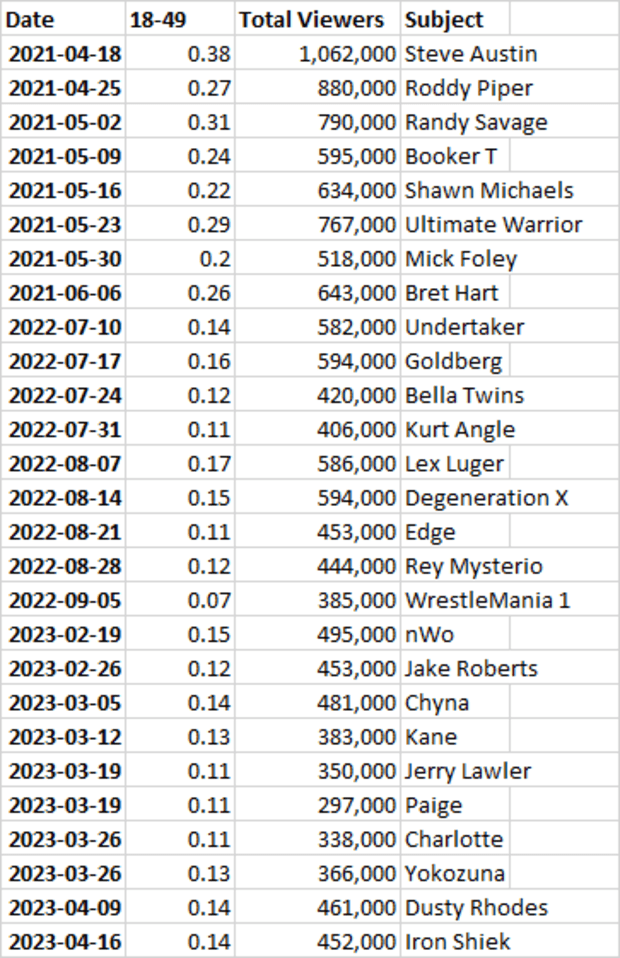
Biography (Ratings)
News
Ric
Flair retires for the final time
Ric
Flair's Last Match
Websites
Ric
Flair official website Ric
Flair - Wikipedia Ric
Flair IMDb)
Ric
Flair's Last Match
Ric
Flair - WWE.com
Ric
Flair YouTube

Profiles
Ric
Flair Wrestling
Wrestling
Legends PPV
Streaming
Pop
Culture Combat
Sports
News
Ric
Flair/Andrade El Idolo vs. Jeff Jarrett/Jay Lethal
announced for 'Ric Flair's Last Match' event in Nashville
- July 18, 2022
Ric
Flair and Andrade El Idolo vs. Jay Lethal and Jeff
Jarrett (w/ Karen Jarrett)
The
Wolves (Davey Richards and Eddie Edwards) vs. Motor
City Machine Guns (Alex Shelley and Chris Sabin)
Rey
Fenix vs. Taurus vs. Laredo Kid vs. Bandido
Kerry
and Ricky Morton (w/Robert Gibson) vs. Brian Billman
Jr and Brock Anderson (w/ Arn Anderson)
Impact
World Championship
Josh Alexander (c) vs. Jacob Fatu
Impact
Knockouts Championship
Jordynne Grace (c) vs. Rachael Ellering vs. Deonna
Purrazzo
Killer
Kross (w/ Scarlett Bordeaux) vs. Harry Smith
Clark
Connors vs. Ren Narita
Ross
and Marshall Von Erich vs. The Briscoes


News
Ric
Flair wrestling again: Breaks retirement for AJPW
in Japan
Pro
wrestling living legend 'Nature Boy' Ric Flair at
63 years will be wrestling for All Japan Pro Wrestling
on January 26th.
Flair
will compete in a tag bout along with Keiji Mutoh
(aka The Great Muta) VS Tatsumi Fujinami and Seiya
Sanada in Ota, Japan.
The
Nature Boy is being promoted as an "active competitor",
clearing up earlier news that was unclear whether
the 2-time WWE Hall of Famer was going to be wrestling
on the tour, which will also feature his son, Reid
Flair.
The
news was confirmed by Japanese wrestling blog Puroresu
Spirit, which tweeted the following confirmation.
@PuroresuSpirit
[All Japan News Update] It's official! All Japan announced
that it will be Keiji Mutoh & Ric Flair vs. Tatsumi...
fb.me/wWvc0j7L
New
Japan Pro Wrestling presented their WrestleMania style
event Wrestle Kingdom VII today on worldwide Internet
Pay Per View from the Tokyo Dome.
Ric
Flair short bio...
The
Nature Boy
Catch
phrases: "a kiss-stealin', wheelin' dealin',
jet-flyin', limousine-ridin' son-of-a-gun!";
Woooooo!
Height:
6'1''
Weight: 243 pounds
From: Charlotte, NC
Career Achievements: 2-Time WWE Hall of Famer, 16-time
World Heavyweight Champion
Signature
Move: Figure-Four Leglock
Original member of "The Four Horsemen"
Only wrestler in history to be inducted into the WWE
Wrestling Hall of Fame twice. (Individually in March
2008 and with the Four Horsemen in March 2012.)
Websites
Ric
Flair official website
Ric
Flair - WWE Hall of Fame official website
All
Japan Pro Wrestling
|

