|
Internet
in Australia: How to Stay Connected Without the Roaming
Shock
Australia
is enormous, and phone coverage doesn't pretend otherwise.
You can have full bars in Sydney's CBD and then nothing
at all a few hours into a road trip, right when you're
relying on your phone for directions, bookings, or
just letting someone know where you are. I found this
out the hard way on a drive out of Alice Springs,
where signal dropped for close to three hours and
the offline map I'd forgotten to download would have
saved a fair bit of guesswork.
Getting
online in Australia isn't complicated once you know
your options. Figuring out which one actually suits
your trip, whether that's a short city break or a
proper lap of the country, is best sorted before you
land rather than after.
Free
Wi-Fi turns up in most hotels, cafes, and airports,
but it's patchy outside the big cities and not something
to trust with online banking. Roaming through your
home provider works too, though the cost depends heavily
on where you're from, and Australia isn't covered
by any regional free-roaming deal the way parts of
Europe are for each other. Below is a comparison of
Wi-Fi, roaming, a local SIM, and an eSIM, so you can
see which one actually fits your trip.
Why
This Matters More in Australia Than Most Places
The
distances do a lot of the work here. A drive from
Sydney to Melbourne covers more ground than London
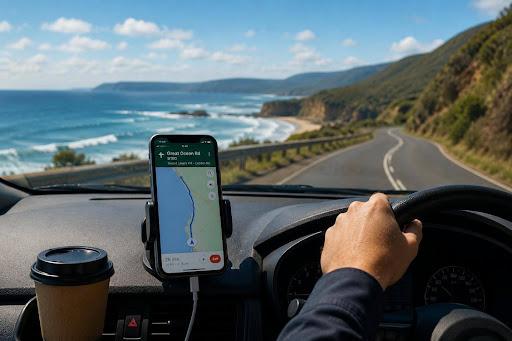
to Rome. The Great Ocean Road, the Red Centre, the
run up to Cairns, all of it means long stretches where
you're relying on offline maps rather than live signal.
Your phone ends up doing more than checking email.
It's your navigation, your accommodation bookings,
and often your only way of confirming a campsite or
tour booking that exists purely as an app confirmation.
None of that requires a perfect signal everywhere.
It just requires knowing where the gaps are and having
a plan that doesn't fall apart the moment you leave
a city.
Comparing Your Options in Australia
Each
option works differently depending on how long you're
staying, how much time you'll spend in cities versus
on the road, and how much you genuinely need to be
online.
| Option |
Typical
Cost |
Setup
Time |
Best
For |
| Public
Wi-Fi |
Free |
None |
Checking
email in cities only |
| Home
roaming |
Varies
widely; often AUD $10-15/day without a bundle |
None |
Short
trips, no time to set anything up |
| Local
Australian SIM |
~12.50-69
AUD depending on data |
10-20
min at arrivals or a store |
Longer
stays, regional coverage priority |
| eSIM |
~USD
$1.55-3.90/day (Holafly, unlimited plans; AUD
equivalent varies with the exchange rate) |
5
min, before you fly |
Convenience,
landing and going straight online |
Public
Wi-Fi
Fine
for checking email over breakfast or looking something
up between meetings. Outside a capital city it more
or less disappears, and what's there is often slow
enough to make a video call painful. I wouldn't plan
a whole day's navigation around it.
International Roaming
The
easiest option on paper is simple. Your phone just
keeps working. The catch is price, which depends entirely
on your home provider and whether it has an Australia-specific
bundle. Without one, you can end up paying full international
rates for the whole trip, and Australia's size means
you'll likely burn through more data than on a shorter
European trip.
A Local Australian SIM
Genuinely
good value, especially for longer stays. Telstra,
Optus, and Vodafone AU all sell prepaid SIMs, with
plans running from around 12.50 AUD for smaller data
packages up to around 69 AUD for larger ones (pricing
checked mid-2026, always confirm current rates directly
with the carrier before you fly). Telstra has the
strongest coverage once you're off the highway, which
matters if your trip goes past the coastal cities,
it owns the most regional tower infrastructure of
the three, which is the practical reason it holds
signal longer in places the others drop. The trade-off
is the usual one: you need a shop, ID, and a few minutes
at arrivals or a convenience store, which isn't always
appealing after a long-haul flight.
An eSIM
This
is the option that skips the shop entirely. You buy
it online, install it before you fly, and it switches
on the moment you land. It won't always beat a local
SIM on price for a long stay, but for anyone who'd
rather not spend their first day in Australia hunting
down a Telstra store, it's the most convenient choice
on this list.
What an eSIM Actually Gets You in Australia
Setup
takes a few minutes: scan a QR code, install the profile,
and it sits ready on your phone until you switch on
data roaming after landing. Coverage from most eSIM
providers in Australia runs on Telstra or Optus infrastructure,
so you get strong signal in Sydney, Melbourne, and
the Gold Coast, with the usual drop-off well into
the Outback or deep in national parks, the same limitation
any local SIM would have.
Pricing
depends on the provider and how long you're staying.
Holafly's unlimited data plans for Australia start
at around $3.90 USD a day for a short trip.
That
falls to roughly $1.55 a day across a full 90-day
stay, which makes a real difference between a quick
city break and a longer working holiday. Hotspot sharing
is typically capped at around 1GB a day. That's enough
for checking email or doing light work on a laptop,
but not for full-time remote work (figures as of mid-2026;
check the provider's current pricing page before buying,
since travel eSIM rates shift fairly often).
When
comparing eSIM
Australia options before a trip, Holafly is one
I'd put on the shortlist, particularly if unlimited
data matters more to you than shaving off the last
few dollars. It suits remote workers, people posting
content daily, or anyone who'd rather not think about
a data counter while road-tripping the Great Ocean
Road. If you're mostly navigating and messaging rather
than uploading video daily, a smaller fixed-data plan,
from Holafly or a competing provider like Airalo,
will likely cost less. It's worth pricing out two
or three providers rather than defaulting to the first
one you find, since plans built for light use versus
heavy streaming vary a lot in value.
A Few Things Worth Doing Before You Fly
*
Check eSIM compatibility first. Most phones from
the last few years support it, including recent iPhones,
Pixels, and Galaxy models, but it's a two-minute check
in your settings before you pay for anything.
*
Download offline maps for the long stretches.
Google Maps areas covering your road trip route, your
airline app, and accommodation confirmations. Grab
these before you leave so a dead zone outside Alice
Springs doesn't slow you down, it's the one step I
skipped and regretted.
*
Keep a copy of the essentials offline. Passport
photo, accommodation bookings, and emergency contacts,
saved to your phone and not just your inbox, in case
you lose signal at the worst moment.
*
Skip public Wi-Fi for anything sensitive. Save
the banking and password resets for your own connection.
Final
Thoughts
A
weekend in Sydney or Melbourne barely needs more than
public Wi-Fi and a bit of patience. Three weeks looping
the country is a different story, where a local SIM's
lower cost per gigabyte starts to matter more than
convenience. If what you want is to land, switch your
phone on, and not think about it again until you're
home, an eSIM is built for exactly that, and for most
short or medium trips, that convenience is worth the
small premium over a local SIM.
|

