|
Kirk
Kerkorian, billionaire investor in film studios and
casinos, dies at 98 - 17th June 2015


CrownBet
promotions

Profiles
Casinos
Gaming
Business
Movies
Hollywood
Sports
Television
Entertainment
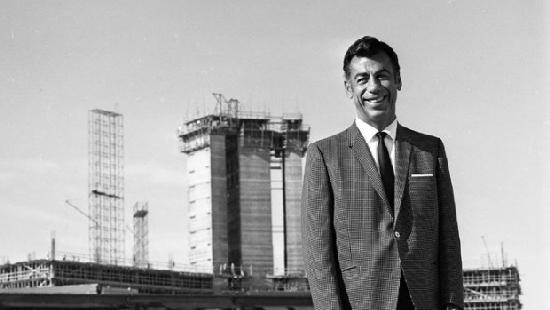
Kirk
Kerkorian at the construction site of the International
Hotel in Las Vegas in 1968. Photo: Don English/Las
Vegas News Bureau
Kirk
Kerkorian, the media-shy investor who became one of
the richest Americans by betting his money on ventures
like casinos and film studios, died Monday night at
his home in Beverly Hills, California. He was 98.
Born
poor, the legendary investor was a brawling amateur
boxer, a daredevil pilot and a high-stakes poker player
before figuring out safer ways to amass a multibillion-dollar
fortune. He pursued strategies that baffled business
rivals and Wall Street analysts and that left him
sometimes on the verge of bankruptcy. Other times,
his moves brought him windfalls.
He
bought and sold MGM three times. He created a commercial
airline, sold it and then purchased it again before
reselling it for good. And in his 80s, he made an
unsolicited but successful bid for Mirage Resorts,
the giant casino company controlled by Stephen Wynn,
the uncrowned king of Las Vegas.
Mr
Wynn was not the only mogul to underestimate Mr Kerkorian.
Mr Kerkorian had earlier outmaneuvred better-known
and seemingly more powerful entrepreneurs. Howard
Hughes tried to undermine his Las Vegas projects,
and Ted Turner mistakenly thought he had bought MGM
studios from Mr Kerkorian for a song.

Kirk
Kerkorian, majority shareholder of MGM Mirage, at
the Nevada Gaming Control Board hearing in Las Vegas
in 2005. Credit: Joe Cavaretta/Associated Press
But
Mr Kerkorian never publicly reveled in his successes
and always avoided the limelight.
"What
good does it do being rich?" the journalist Dial
Torgerson quoted him as saying in the biography "Kerkorian:
An American Success Story" (1974). "I can't
do what I want to do. I don't like to get dressed
up and go to see bankers. I hate that kind of thing."
Mr
Kerkorian skipped most shareholder meetings at the
companies he owned, and he said little when he did
attend. But he resented being portrayed as a recluse.
"I
have 30- or 40-year friendships that I prefer to meeting
new people," he told The Las Vegas Review-Journal
in 1999 in one of his rare interviews. "Just
because I don't go to a lot of events and I'm not
out in public all the time doesn't mean I'm antisocial."
His
close friends included Cary Grant and Frank Sinatra,
who often joined him at Los Angeles restaurants and
Las Vegas gambling tables.
He
was a polarising figure. Some said he was an unscrupulous
manipulator who disregarded the rights of minority
shareholders. On occasion he was sued and forced to
settle such allegations out of court.
But
his defenders insisted that any investors who stuck
by him were bound to make big returns.
"Kirk
has always made money for people who buy in with him,"
Lee Isgur, an analyst with Paine Webber, told The
New York Times in 1985.
Lightweight
boxer
Kerkor
Kerkorian — he americanised his name to Kirk
as a boy — was born in Fresno, California, on
June 6, 1917, one of four children of Armenian immigrants.
His mother, Lily, was a homemaker; his father, Ahron,
was a fruit merchant whose get-rich-quick schemes
often left his family struggling to stay afloat.
"We
moved at least 20 times when I was a kid," Mr
Kerkorian told Fortune magazine in 1969."We often
could not pay our rent and would get booted out."
Young
Kirk got no further than the eighth grade, leaving
school to take odd jobs. He became a promising lightweight
boxer, winning 29 of 33 amateur bouts, but quit the
ring in 1939 to take flying lessons and soon became
a private pilot and later an instructor.
In
World War II, Mr Kerkorian ferried bomber planes across
the Atlantic and as far as India for the British Royal
Air Force. After the war he purchased surplus military
transport planes, refurbished them and sold them around
the world, using the profits to buy a small air charter
operation, based in Los Angeles, in 1947.
Mr
Kerkorian often flew Hollywood entertainers into Las
Vegas, which was becoming a gambling capital, and
joined them at the blackjack and dice tables, where
he became renowned as a high roller. It was in Las
Vegas where he met Jean Maree Hardy, a dancer and
choreographer. They married in 1954 and had two daughters.
That marriage ended in divorce after almost 30 years.
(His first marriage to Hilda Schmidt had also ended
in divorce, in 1951.)
His
daughters Tracy Kerkorian and Linda Kemper as well
as three grandchildren survive him, a family spokesman
said.
Studebaker
Mr
Kerkorian bought property in Las Vegas, just off the
Strip, in 1962. That year he merged his charter company,
Trans International Airlines, with the Studebaker
Corporation, retaining operating control.
Using
Studebaker revenue, he expanded the airline's fleet
and destinations. He then repurchased the airline
in 1964 and left Studebaker. Over the next three years
he sold the airline in two separate transactions,
making more than $US100 million in overall profits
and funneling the proceeds into the three business
arenas — airlines, gambling resorts and film
studios — that would sustain him as an investor
for the rest of his life. By the end of 1969 Mr Kerkorian
had beaten out the Bronfman family, the Canadian liquor
magnates, for control of MGM and amassed almost 40
per cent of its shares. Meanwhile, he began to develop
his Las Vegas acreage, breaking ground in 1968 for
what he promised would be the largest hotel and casino
in the world.
The
project infuriated Hughes, the reclusive former airline
and movie magnate, who had recently moved to Las Vegas
intending to dominate the casino and resort business.
Hughes announced a huge expansion of his own Sands
Hotel, aimed at convincing creditors that Mr Kerkorian's
International Hotel would not be viable in what looked
like an overbuilt market. In the end, Mr Kerkorian
found other creditors and completed his hotel on schedule
in 1969.
Soon
he was facing bigger threats. The 1969-70 recession
caught him badly overextended. The Securities and
Exchange Commission prevented his holding company,
the International Leisure Corporation, from making
a secondary offering of stock, which would have helped
him repay his loans, because the Flamingo Hotel, an
International Leisure property, had once been owned
by racketeers. Mr Kerkorian was sinking fast. His
International Leisure stock was worth $US180 million
at the beginning of 1970, but a year later he was
forced to sell half his holdings in the company for
$US16.5 million.
'Sometimes
you lose'
Sometimes
you lose, but that's the nature of the game,"
he was quoted as saying by Time magazine in 1970.
"There's always another game and another chance
to win."
He
found one when he sought help in shoring up his finances
from MGM, in which he had accumulated a controlling
share. At his prodding, the MGM board announced that
it would build the MGM Grand in Las Vegas, surpassing
Mr Kerkorian's International Hotel as the world's
largest gambling and resort hotel.
The
original MGM Grand opened in 1973 with more than 2000
rooms. A year later, Mr Kerkorian increased his holdings
in MGM to just over 50 per cent.
With
a strong flow of revenue from his Las Vegas operations,
Mr Kerkorian sought to expand his Hollywood investments.
He bought 25.5 per cent of Columbia Pictures in 1978,
which he later sold. In 1981, he lost a bid to buy
20th Century Fox but succeeded in acquiring United
Artists. He then split MGM into two publicly owned
entities: MGM/UA Entertainment, which included film
and television production and a large library of films;
and MGM Grand Hotels, which owned and managed hotels,
casinos and luxury cruise ships.
By
1986, Mr Kerkorian had agreed to sell MGM/UA, which
was struggling, to Mr Turner, the cable television
magnate, for $US1.5 billion. Hollywood rivals and
Wall Street analysts considered it a good deal for
Mr Kerkorian. It became a terrific one a year later,
when Mr Turner, crushed by debts, sold all but MGM's
film library back to Mr Kerkorian for only $US300
million. In effect, Mr Kerkorian had sold off the
MGM library for $US1.2 billion.
Mr
Kerkorian did not hold on to MGM/UA for long. In 1990,
he sold it to the Italian financier Giancarlo Parretti
and his holding company, Pathé Communications,
for $US1.3 billion. A year later Mr. Parretti was
ousted by his main creditor, the French bank Crédit
Lyonnais, which then sued Mr. Kerkorian, accusing
him of committing fraud by knowingly selling worthless
assets. The case was settled out of court in 1995
when Mr. Kerkorian agreed to pay an undisclosed amount.
The
battle for Chrysler
By
then Mr Kerkorian was focused on the biggest gamble
of his career: an effort to take over the Chrysler
Corporation. In 1995, with the support of its former
chairman, Lee A. Iacocca, he proposed to buy Chrysler
for $US22.8 billion and take it private. Chrysler's
board rejected the proposal.
But
he and the board struck a deal in 1996 when he agreed
to limit his Chrysler holdings to no more than 13.8
per cent of its stock and the company agreed to rid
itself of its nonautomotive businesses. In 1998, Daimler-Benz,
the maker of Mercedes-Benz automobiles, acquired Chrysler
in a $US36 billion merger. The deal was a windfall
for Mr Kerkorian, raising the value of his Chrysler
holdings to nearly $US5 billion, more than triple
the original investment he had made in 1990.
Even
as he battled Chrysler, Mr Kerkorian was moving back
into the film business. In 1996, after settling his
legal disputes with Crédit Lyonnais, he bought
back MGM/UA for $US1.3 billion. It was Mr Kerkorian's
third takeover of MGM, and he seemed determined to
restore the company's vitality. But he ended up selling
it in 2004 to a consortium led by Sony.
MGM
burns down
He
held onto his interest in Las Vegas gambling resorts,
however. After the MGM Grand burned down in 1980,
leaving more than 80 people dead, he rebuilt it and,
in 1986, sold it to the Bally Manufacturing Corporation,
which renamed it Bally's Grand.
Then,
in 1993, he unveiled a new MGM Grand, built at a cost
of more than $US1 billion. (The original building
had been badly damaged in a fire in 1980.) Again laying
claim to be the largest hotel and casino in the world,
it had 5005 rooms, 170,000 square feet of casinos,
a 15,000-seat arena, a 33-acre theme park and a giant
gold lion serving as its entrance.
"He
doesn't do it for the money," Mr Iacocca, then
an MGM Grand board member, said about Mr Kerkorian
in The Los Angeles Times in 1993. "He does it
because he gets bug-eyed like a little kid when he
goes through the place."
In
1999 Mr Kerkorian married Lisa Bonder, a former tennis
pro. The marriage lasted only one month, and in 2002
she asked Los Angeles Superior Court for the largest
child-support award in California history, $US320,000
a month.
A
lawyer for Mr Kerkorian, Terry Christensen, was later
convicted of wiretapping Ms Bonder's phone. Prosecutors
said he had paid Anthony Pellicano, a private investigator,
$US100,000 to eavesdrop after Ms Bonder sued Mr Kerkorian
for child support. A judge rejected Mr Christensen's
contention that he hired Mr Pellicano to help determine
the biological father of the child after it had been
made public that the child was not Mr Kerkorian's.
Mr Pellicano was also convicted.
By
the time the marriage ended, Mr Kerkorian was worth
about $US7 billion, according to Forbes magazine.
But his appetite for acquisitions was as great as
ever.
Chasing
the Mirage
In
February 2000, his MGM Grand made an unsolicited offer
to acquire Mirage Resorts, the company created by
Mr Wynn to help turn Las Vegas into a major family
destination. Within two weeks, Mirage Resorts agreed
to be acquired by MGM Grand for $US4.4 billion in
cash. The deal left Mr Kerkorian in control of five
of the most glittering casino resorts on the Las Vegas
Strip, as well as casinos in Australia and elsewhere
in the United States.
Nearing
88 years old in 2005, Mr Kerkorian made yet another
splash on Wall Street by buying a 9.9 per cent stake
in General Motors. Though financially troubled, GM
remained the world's largest automaker, and Mr Kerkorian
was betting that he could force it to pursue a more
successful strategy. But his gamble failed when GM's
management refused to accept his proposal to sell
off money-losing car brands and form an international
alliance with the rival automakers Nissan and Renault.
Mr Kerkorian sold his GM investment in 2006.
He
was not entirely finished with the automobile business.
In 2008 he acquired a 6.5 per cent stake in the Ford
Motor Company, only to sell it within a few months
after Ford's stock plummeted. By that time his casino
business had sustained heavy losses as well. But Mr
Kerkorian remained undeterred.
"Kirk
has seen this before," his friend Alex Yemenidjian,
a former MGM chief executive, told The Times in 2009.
"To him, this is just a bump on the road."
Mr.
Kerkorian offered his own assessment of the fires
that motivated him. "When you're a self-made
man, you start very early in life," he told The
Las Vegas Review-Journal in 1999. "In my case
it was at 9 years old when I started bringing income
into the family. You get a drive that's a little different,
maybe a little stronger, than somebody who inherited."
The
New York Times
|


