|
Trump sues Twitter, Google and Facebook alleging 'censorship'
- 8th July 2021

Profiles
Politics
United
States World
Digital
Social
Sports
Betting Television
Wrestling Business
Gaming Entertainment
Pop Culture
Steaming
Advertising
Promotions
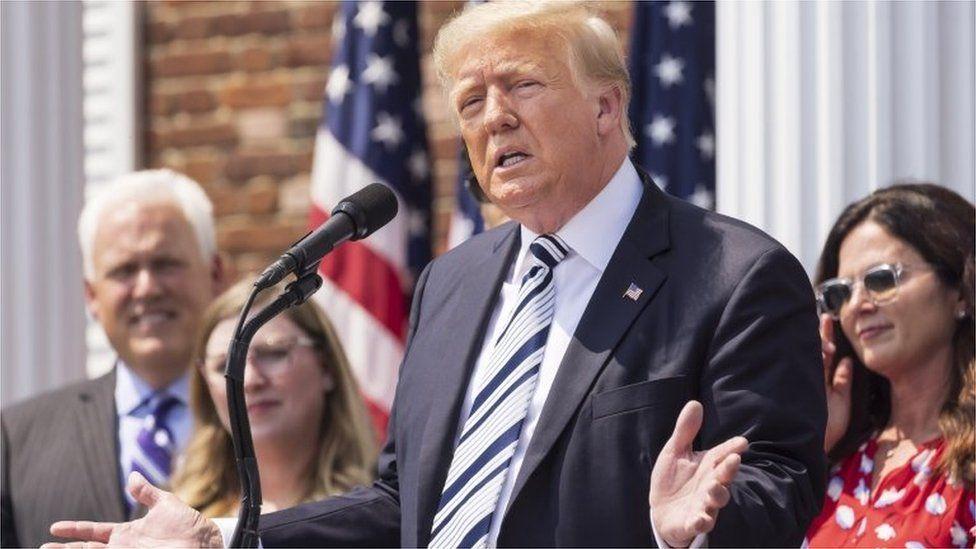
Former
US president Donald Trump has filed a lawsuit against
tech giants Google, Twitter and Facebook, claiming
that he is the victim of censorship.
The
class action lawsuit also targets the three companies'
CEOs.
Mr
Trump was suspended from his social accounts in January
over public safety concerns in the wake of the Capitol
riots, led by his supporters.
On
Wednesday, Mr Trump called the lawsuit "a very
beautiful development for our freedom of speech".
In
a news conference from his golf resort in Bedminster,
New Jersey, Mr Trump railed against social media companies
and Democrats, who he accused of espousing misinformation.
"We
are demanding an end to the shadow-banning, a stop
to the silencing, and a stop to the blacklisting,
banishing, and cancelling that you know so well,"
he said.
The
suit requests a court order to end alleged censorship.
Mr Trump added if they could ban a president, "they
can do it to anyone".
None
of the tech companies named have yet responded to
the lawsuit, which was filed to a federal court in
Florida.
Mr
Trump was joined at the announcement by former Trump
officials who have since created the not-for-profit
America First Policy Institute.
The
former president called the post that got him banned
from Twitter, "the most loving sentence".
According
to Twitter, the tweets that resulted in Mr Trump's
ban for "glorification of violence" were
from 8 January, two days after the rioting in the
nation's capital. The riot followed his repeated claims,
without evidence, that the election was rigged in
Joe Biden's favour.
He
wrote that the "great patriots" who voted
for him will have "a giant voice" and "will
not be disrespected or treated unfairly in any way,
shape or form", and in another post said he would
not attend President Joe Biden's inauguration.
At
the same time on Wednesday, Mr Trump's Republican
allies in Congress released a memo describing their
plan "to take on Big Tech".
The
agenda calls for antitrust measures to "break
up" the companies, and a revamping of a law known
as Section 230.
Section
230, which Mr Trump tried to repeal as president,
essentially stops companies like Facebook and Twitter
from being liable for the things that users post.
It gives the companies "platform" rather
than "publisher" status.
"It's
a liability protection the likes of which nobody in
the history of our country has ever received,"
Mr Trump said, criticising the law on Wednesday.
He
added that the law invalidates the companies' statuses
as private companies.
The
lawsuit has been criticised by legal experts, who
pointed to Mr Trump's habit of issuing lawsuits for
media attention but not aggressively defending the
claims in court. His argument of free speech infringement
has also been questioned by analysts, as the companies
he accuses have those same First Amendment protections
in determining content on their sites.
Trump
struggles to be heard
Donald
Trump's muzzling on social media has been extremely
effective.
His
megaphone removed, Trump has struggled to be heard
at times.
His
plans for his own social media platform have so far
come to nothing.
This
lawsuit illustrates, if it were needed, just how important
the big social media companies are to him.
A
key strategy of Trumpism is being able to speak directly
to voters - bypassing traditional media.
Facebook
proved particularly important to Trump - giving him
access to millions of Americans at the click of a
button.
Experts
believe the lawsuits are unlikely to succeed.
Mr
Trump will argue that his First Amendment rights have
been violated. But tech companies will say that, as
private companies, they have the right to decide who
uses their platform - an argument that is likely to
succeed.
House
Republicans, too, want to introduce legislation that
will "break up" Big Tech. However, without
a majority in either house they will struggle to do
so.
Trump
desperately wants to get back into your newsfeed,
but that may not be likely to happen anytime soon.
| 
