The
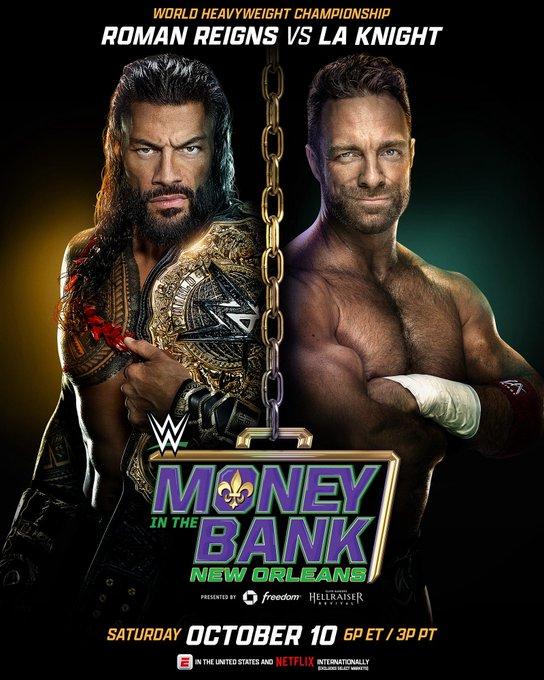
2026 Money in the Bank, also promoted as Money in
the Bank: New Orleans, is an upcoming professional
wrestling pay-per-view (PPV) and livestreaming event
produced by WWE. It will be the 17th annual Money
in the Bank event and will take place on Saturday,
October 10, 2026, at the Smoothie King Center in New
Orleans, Louisiana, held for wrestlers from the promotion's
Raw and SmackDown brand divisions. The event is based
around the Money in the Bank ladder match in which
multiple wrestlers compete to retrieve a briefcase
hanging above the ring that contains a contract that
guarantees a world championship match of the winner's
choosing at any time within the next year.
This
will be the first Money in the Bank to be held in
October, making it the latest scheduled Money in the
Bank in a calendar year, and the first one to be held
after SummerSlam, as the event is generally scheduled
sometime between WrestleMania and SummerSlam. This
will also be the first Money in the Bank to air on
the ESPN streaming service in United States. (Wikipeedia)
The
company has lots of revenue streams, but one is dominant.
WWE
(NYSE:WWE)
makes money from live events, its streaming network, merchandise sales, and a
few other areas, but it has one source of revenue. The bulk of the company's income
(over 70%) comes from selling television rights. That's an area where the company
has recently signed two major deals for its flagship programs at huge increases
over what they were previously getting paid.
To
catch full episodes of all The Motley Fool's free podcasts, check out our podcast
center. A full transcript follows the video.
This
video was recorded on April 9, 2019.
Nick
Sciple: Dan, WrestleMania just happened on Sunday. What was your takeaway from
that event?
Dan
Kline: That no TV show should be five and a half hours long. There were too many
emotional peaks. Usually at WrestleMania, you build to one underdog finally has
his day, holding the championship up. They had like six of those. By the time
they got to the main event, I was exhausted. Admittedly, I'd been watching most
of it on my phone in a bar at the hotel I'm staying in, then on my laptop in my
hotel room, which is not the most pleasant way to watch television.
Sciple:
Yeah, Dan, I didn't quite get the full experience of WWE. I was in Montreal, Canada,
for a friend's bachelor party over the weekend. Did catch the last couple of hours
of the show. I tell you what, the Triple H vs. Batista match I thought was incredible.
Good job working the different body parts and things like that. I thought that
was great example of good wrestling.
Dan,
today we're talking about WrestleMania, a little bit about wrestling. We both
like that a lot. But, we're going to talk about WWE as a business.
Kline:
[laughs] Yes, as a business.
Sciple:
First off, the top of the show, let's talk about where they make their money.
As many people will know, WWE is the premiere global wrestling brand. It's kind
of the NFL of professional wrestling. Where are they making their money? Where
does most of their money comes from as a business?
Kline:
Television rights. This has been a huge question mark until very recently for
WWE. They were always a difficult television property in that wrestling is considered
a little downstream. WWE has done a good job getting mainstream advertisers to
be willing to advertise, but that's a recent thing. For the last few cycles of
TV rights before the current one, their deal would come up, and they would only
have one bidder. So Comcast would say, "Hey, we'll give you a little more."
Now, the rights world has exploded so much that Comcast is paying them basically
what they used to pay for five hours of programming for just the three-hour Monday-night
show. And Fox is paying them $1 billion over five years on top of that for their
No. 2 show, which is actually going to be on network broadcast television.
Sciple:
We'll talk a little bit later about the details around those TV deals. Just to
start off, let's unpack a little bit about what rights we're selling. WWE produces
five hours of weekly original content. Like you mentioned, they have two shows.
Kline:
Those are the A-list shows. WWE actually produces all sorts of, let's call it
curtain programming, the main event, which is a one-hour show to get some of the
talent on the card. They have NXT, which is their AAA territory. They have 205
Live, which is the lighter-weight wrestlers who fly around more. Some of that
is programming that's on their network. WWE Network is a paid subscription service.
It was a hedge against, "What if nobody bid for one of these properties?"
"Well, we could take it, put it on our own network, maybe add a million subscribers,
keep the revenue in the same place."
Then,
they also have the TV revenue from their E! deal and their USA deal for Miz &
Mrs., which is a reality show, Total Divas, Total Bellas, which are reality shows.
Then there's the like occasional tryout stuff. They've had cartoons, they had
a Saturday-morning kids show. They have different cuts of things for international.
I don't know if they have a Hulu show still, but they used to have an edited version
of Raw for Hulu.
Sciple:
They still have that.
Kline:
But the bulk of their money is made from licensing Raw and SmackDown, the two
A-list shows, not just in the U.S. The U.S. is the most important deal, but there's
also huge money for them to be made in some of the major markets around the world.
Sciple:
Dan, you're exactly right. The media portion of the business, as you mentioned,
is about 73% of their revenue. You mentioned the network aspect of the business.
That's been an interesting phenomenon over the past several years. They launched
that in 2014 and have transitioned from the old pay-per-view model to this more
consistent "Pay $9.99 a month as a network subscriber and you get all the
pay-per-views each month."
Kline:
The premise of the network makes sense, but in some ways, there's a disconnect.
So, they looked at me and you, and they said, "OK, you guys are wrestling
fans, but you're only buying WrestleMania, and once a year, there's a pay-per-view
that you really want to see. So you're spending $59.99 twice a year. That's $120.
That's $9.99 a month." So the proposition was, "I bet for $9.99 a month,
Dan and Nick would want all the pay-per-views, all this archival content, some
original shows we produce, some highlights and documentaries, all sorts of cool
stuff." Actually, the answer has mostly been, somehow that math doesn't compute
to people. They thought they would have two million subscribers a year ago, and
they have about one and a half, and that number goes down after WrestleMania season.
It hasn't been the global success they thought it would be.
But
there's a caveat to that. The second they signed these television deals, they
for five years decided that the network would be downplayed. They're not going
to produce as much original programming there. They almost never mention the network
on the television shows. There used to be an endless refrain of "$9.99 a
month!" They don't need the network as much as they used to, and they have
to make sure people watch their key shows, or else those deals are going to go
away.
Sciple:
Yeah. It's an interesting phenomenon, how that fits into part of their business.
Something to watch going forward. As you said, it hasn't quite grown as much as
the business would have liked. But when you've got an audience of one and a half
million subscribers you can depend on month over month, interesting part of the
business. As we mentioned, Dan, the media is the biggest part of the business,
over 70% of their revenue. That's been growing over time as sports and sports-related
media rights have been moving up over time.
The
rest of their revenue comes from producing live events as well as selling merchandise.
Those haven't seen quite as much growth over the past few years. It's declined
as a portion of revenue over the past several years. Live attendance over the
past several quarters has been down in the mid-single-digit range. How should
we think about those aspects of WWE's business and how it fits into the investment
thesis for the company?
Kline:
Wrestling tends to be cyclical. You have a breakout character like The Rock or
Hulk Hogan, Stone Cold Steve Austin. That drives merchandise sales, drives the
business. It makes it cool. A fifth grader is not going to buy a wrestling T-shirt
if it's not cool. Certainly, an adult male is not wearing a wrestling T-shirt
unless wrestling is very in vogue or we're very out of touch. Right now, the hot
wrestling tends to be the smaller independent scene. I don't know if you've seen
Bullet Club T-shirts out there. They're a new Japanese wrestling faction. Chris
Jericho, a very famous longtime WWE wrestler, is on his own and working with a
new group, has done really well selling shirts at Hot Topic. Some of the people
wearing Chris Jericho shirts or Young Buck shirts bought at Hot Topic have no
idea that they're wrestlers. They might think they're bands or just logos or who
knows what. But the cool factor isn't there. WWE is going to be hurt by that.
They're
also hurt by -- their No. 1 star in terms of mainstream appeal is John Cena. He
sells an enormous amount of merchandise to kids. Well, he's barely active. He's
a Hollywood movie star who comes back for big shows. When there's an arena show,
he's not on the show, so the kids aren't buying his hat and his sign and his T-shirt
and his headband and probably his bobblehead doll and his ice cream and who the
hell knows what else. That's going to hurt merchandise sales.
Maybe
this pops back up because some of the women wrestlers are having a creative peak.
Maybe it becomes cooler for girls to wear Charlotte Flair, Becky Lynch, or Ronda
Rousey shirts. But that hasn't in any way been the case yet.
Daniel
B. Kline owns shares of World Wrestling Entertainment. Nick Sciple has no position
in any of the stocks mentioned. The Motley Fool recommends Comcast. The Motley
Fool has a disclosure policy.